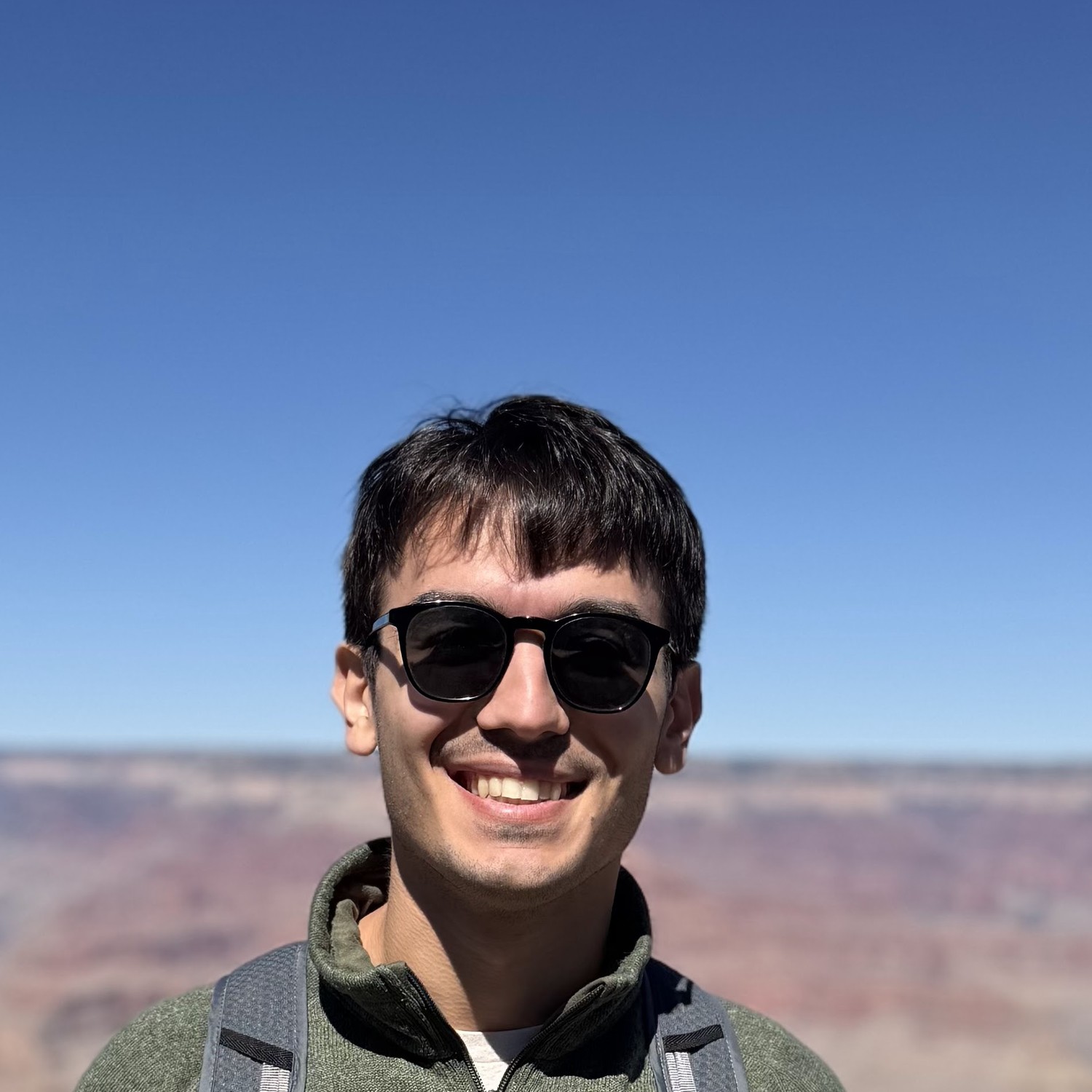
About
I’m a software engineer interested in performance optimization for large, real-world systems. I’m currently a member of technical staff at Anthropic.
Before Anthropic, I was a machine learning systems engineer at Meta, building compilers, frameworks, and kernels for MTIA training/inference within the PyTorch organization. Before that I built compiler toolchains at the startup Reservoir Labs and continued that work at Qualcomm following the acquisition, focusing on machine-learning compilers for wide-vector VLIW DSP accelerators. Earlier, I was a Ph.D. student at Princeton studying bias mitigation in machine learning, and as an undergraduate at Columbia I worked on computer graphics, physics-based simulation, and geometry processing.
Projects
- SESE Regions. Python implementation of the Johnson-Pearson-Pingali algorithm for canonical single-entry/single-exit regions and program structure trees, with Graphviz exporters for CFG and region visualization.
- Offline PlantID. SwiftUI iOS app for offline plant identification using a TensorFlow Lite model trained on iNaturalist data, with on-device inference.
- IMDb Movie Toolkit. CLI tool that aggregates IMDb titles by year with filters for votes, ratings, genres, title type, runtime, and output formats. HTML sample
Publications
- Towards Fairness in Visual Recognition: Effective Strategies for Bias Mitigation. Zeyu Wang, Klint Qinami, Ioannis Karakozis, Kyle Genova, Prem Nair, Kenji Hata, and Olga Russakovsky. IEEE/CVF Conference on Computer Vision and Pattern Recognition (CVPR), 2020.
- Towards Fairer Datasets: Filtering and Balancing the Distribution of the People Subtree in the ImageNet Hierarchy. Kaiyu Yang, Klint Qinami, Li Fei-Fei, Jia Deng, and Olga Russakovsky. ACM Conference on Fairness, Accountability and Transparency (FAccT), 2020.
Talks
-
Compiler-Driven Performance Optimization for Neural Networks.
Klint Qinami. CDP Workshop 2025.
Compiler optimization techniques developed for MTIA's next-generation architecture.
Abstract
Undergraduate Work
Computer Science
- QClang: High-Level Quantum Computing Language. Klint Qinami, Connor Abbott (2018). A research prototype language and compiler for expressing quantum programs at a high level. GitHub
- Quantifying Geometric Entanglement: the Linking Number of Two Open Curves. Klint Qinami, Eitan Grinspun (2017). A computational geometry study connecting curve topology with linking number estimation.
- Blis: Better Language for Image Stuff. Connor Abbott, Wendy Pan, Klint Qinami, Jason Vaccario (2017). A small language and toolchain for concise image-processing programs. GitHub
Math
- Algebraic Topology. A set of notes on homology, cohomology, and fundamental groups.
- Point-Set Topology. Notes covering metric spaces, continuity, and compactness.
- Modern Algebra. Notes on groups, rings, and fields with worked examples.
Physics
- Superconductivity Lab Software. Control and analysis tools for a superconductivity experiment lab setup. GitHub
- Quantum Hall Effect Software. Data acquisition and visualization software for quantum Hall measurements. GitHub
Elsewhere
- GitHub - Repos, tools, and source code.
- Stack Exchange - Math answers and discussions.